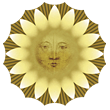
What is the story behind our stud name "Zauberland Alpakas" and our logo? It isn't about magic in the sorcerer's sense, but about "enchanting" animals – about God's beautiful creation.
When we were looking for a logo 25 years ago, we were fascinated by the mythology according to which the alpaca is a "gift of the gods" – more precisely, a gift from "Inti," the Inca sun god, to the Peruvian people. No other people on earth could call this beautiful animal, with its precious fleece, their own. Today the charming alpaca is growing in popularity all over the world. Of course there is no "sun god Inti" – only the almighty God, our heavenly Father, the God of Abraham, Isaac and Jacob.
The story of the sun god reminded me at the time of the early history of my mother's family, the von Wedel family. In the early Middle Ages, the family of the counts and lords von Wedel possessed a bronze or golden statue of a sun goddess, the so-called "Güldene Fru" (Golden Woman). It is believed today that the family – first documented in the early 12th century as among the elders of Stormarn – had inherited this statue from their own pre-Christian past. The sculpture later came to the Ethnological Museum in Berlin. The coat of arms of the von Wedel family still shows a sun wheel to this day, which was later also interpreted as a judgment wheel. Since their first documented mention over 800 years ago, the Wedels have of course been Christians; no one worships a sun god today.
What is the story behind the Zauberland logo?
Our logo was derived from this North German "sun goddess." It is meant to express that alpacas, like everything in the world, were created by Almighty God. The all-seeing eye illustrates God's omnipotence and shows that it matters to him that we keep his commandments and preserve his creation – and, with that, the responsibility we bear as breeders and keepers of these precious animals.
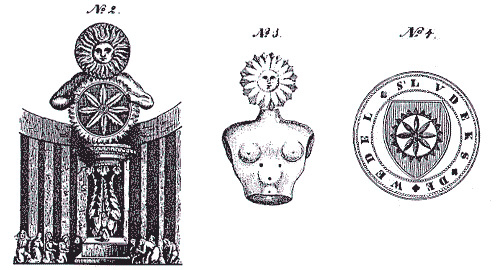
Fig. 2 shows a sun temple in which the old Saxons worshipped the sun. Roman historians reported that the old Saxons had built altars in many places across northern Germany – among them in Wedel (Velano) in Holstein and in Salzwedel (Sol-Vel) in the Altmark region. "Sol" means sun, "Weel" means house.
Fig. 3 shows a statue of the von Wedel "Güldene Fru." She wore a sun disc on her body, fastened at three visible points.
Fig. 4 is one of the earliest depictions of the von Wedel coat of arms, a seal from the 13th century – at its center stands the sun wheel, or judgment wheel.
Why the Name Zauberland?
Alpacas are special, "enchanting" animals: gentle, intelligent and curious, with a charm that can win you over completely. Linda Tellington-Jones once said: "When an alpaca looks at you with its big eyes, God is looking at you."
I will never forget how a girl of perhaps six years old, at the first British alpaca show in April 1999, petted a young alpaca for the very first time – her mouth fell open in delight, and then she whispered: "Ohh, mum, mum, this is the softest thing in the whole wide world…"
Zauberland ("Magic Land") is a land that exists in the longing of many people: the longing for a realm of peace. There are moments when people become aware of just how wonderful God's creation is. Anyone who spends time with alpacas very often feels this sense of joy and happiness.
Our breeding began with a dream: even before I acquired my first alpacas, I dreamed of an island in a wide river, to which an old man rowed me in a boat. There, a whole herd of Suri alpacas came galloping toward me, all with shining pencil locks reaching down to the ground. One Suri proudly stepped in front of me and said: "Welcome to our world!" A short time later the dream became reality – our farm was the first to begin Suri breeding in Germany in the year 2000, with 22 Suri mares and two Suri herdsires.